Reef tank water parameters: ideal values chart
Which values to aim for in a saltwater reef tank, how often to test each parameter and why it matters. With a reference chart you can keep handy every time you run your tests.
In a mixed reef the usual values are: salinity 1.025–1.026 SG, temperature 24–27 °C (75–81 °F), pH 7.9–8.4, KH 7–11 dKH, calcium 380–450 ppm, magnesium 1,250–1,400 ppm, nitrate 1–10 ppm and phosphate 0.03–0.1 ppm. Ammonia and nitrite at zero in a cycled tank. More than the exact number, what matters is choosing a target within the range and keeping it stable.
Ideal water parameters chart for a reef tank
Guideline ranges for a mixed reef (softies, LPS and some SPS). You can log all of them in Salicora, salinity and ammonia included. The Salicora column shows the target range the app suggests when you create an aquarium; you can change it at any time.
Swipe the table to see every column →
| Parameter | Typical range | Salicora default | How often to test | Why it matters |
|---|---|---|---|---|
| Salinity | 1.025–1.026 SG (34–35 ppt) | 1.024–1.026 SG | Daily or several times a week | The foundation of everything. It rises as water evaporates: always top off with RO/DI water. |
| Temperature | 24–27 °C (75–81 °F) | 24–26 °C (75–79 °F) | Daily | What matters most is that it doesn’t swing. Above 28–29 °C (82–84 °F) the risk of bleaching rises. |
| pH | 7.9–8.4 | 8.1–8.4 | Weekly, or continuously with a probe | Drops at night and rises during the day; proper KH keeps it stable. |
| Alkalinity (KH) | 7–11 dKH | 8–9.5 dKH | 2–3 times a week while adjusting; weekly after that | Carbonates for coral skeletons. No more than ±0.5 dKH per day. |
| Calcium (Ca) | 380–450 ppm | 410–450 ppm | Weekly | Along with KH, what stony corals and coralline algae consume. |
| Magnesium (Mg) | 1,250–1,400 ppm | 1,300–1,400 ppm | Every 1–2 weeks | Keeps calcium and carbonates from precipitating. With low Mg, KH and Ca are hard to hold. |
| Nitrate (NO₃) | 1–10 ppm | 5–10 ppm | Weekly | A nutrient. High levels feed algae; at zero, corals lose color. |
| Phosphate (PO₄) | 0.03–0.1 ppm | 0.03–0.1 ppm | Weekly | Above 0.1 ppm, algae and cyanobacteria tend to show up. |
| Nitrite (NO₂) | < 0.2 ppm (ideally ≈ 0) | 0–0.2 ppm | During cycling or if something goes wrong | A sign the biological filter hasn’t finished maturing. |
| Ammonia (NH₃/NH₄⁺) | 0 ppm | 0–0.05 ppm | During cycling or after a death in the tank | Toxic to fish and invertebrates even in small amounts. |
| Potassium (K) | 380–420 ppm | 380–420 ppm | Monthly or with ICP | Linked to coral color and tissue health. |
| Iodine (I) | 0.04–0.06 ppm | 0.04–0.08 ppm | Monthly or with ICP | Used by soft corals and crustaceans. Better not to overdose. |
| Fluoride (F) | 1.2–1.4 ppm | 1–1.5 ppm | Occasionally, with ICP | Trace element linked to pigmentation in some corals. |
Guideline values based on the ranges commonly used in the reef hobby. Every system is different: if your corals are doing well at slightly different, stable values, don’t force them.
By type of tank
The big difference between one tank and another lies in nutrients and in how strict stability needs to be:
| Type of tank | Nitrate (NO₃) | Phosphate (PO₄) | What to watch |
|---|---|---|---|
| Soft corals | 5–15 ppm | 0.05–0.15 ppm | They tolerate more nutrients. Watch salinity and temperature above all. |
| Mixed reef / LPS | 2–10 ppm | 0.03–0.1 ppm | Stable KH, calcium and magnesium, with consumption that grows as the corals do. |
| SPS-dominant | 1–5 ppm | 0.02–0.08 ppm | Very sensitive to KH swings: test often and dose consistently. |
| Fish only (FOWLR) | < 20 ppm | < 0.2 ppm | Less demanding: the key is zero ammonia and nitrite, plus regular water changes. |
How the parameters affect each other
Calcium, KH and magnesium go together
Stony corals consume calcium and carbonates at the same time, so when one drops the other usually does too. Magnesium isn’t consumed as much, but it keeps calcium and carbonates from precipitating: with low magnesium you’ll find KH and calcium hard to maintain no matter how much you dose. If you correct one, test all three.
KH and pH
KH buffers pH changes. With low KH, pH swings more between day and night; with stable KH, pH stays put. If your pH is low, check KH first, then the ventilation in the room.
Nitrate and phosphate: neither zero nor high
Both are nutrients. If they rise, algae and cyanobacteria appear; if they’ve been at zero for weeks, corals lose color and grow less. What you want are low but measurable levels. As a reference, a ratio of about 10 to 1 in ppm (for example 5 ppm NO₃ and 0.05 ppm PO₄) is usually a good balance; it matches the Redfield ratio (16:1 in moles).
Salinity and temperature: the foundation
These are the parameters that change fastest and affect everything else. Evaporation raises salinity every day: an auto top-off (ATO) with RO/DI water keeps it stable. And a good heater with a controller prevents temperature scares.
How to track your parameters in Salicora
These screenshots come from a demo account with two months of tests. Everything is in range except phosphate, which has been creeping up for weeks until it left the target: exactly the kind of problem you only see by looking at the trend.
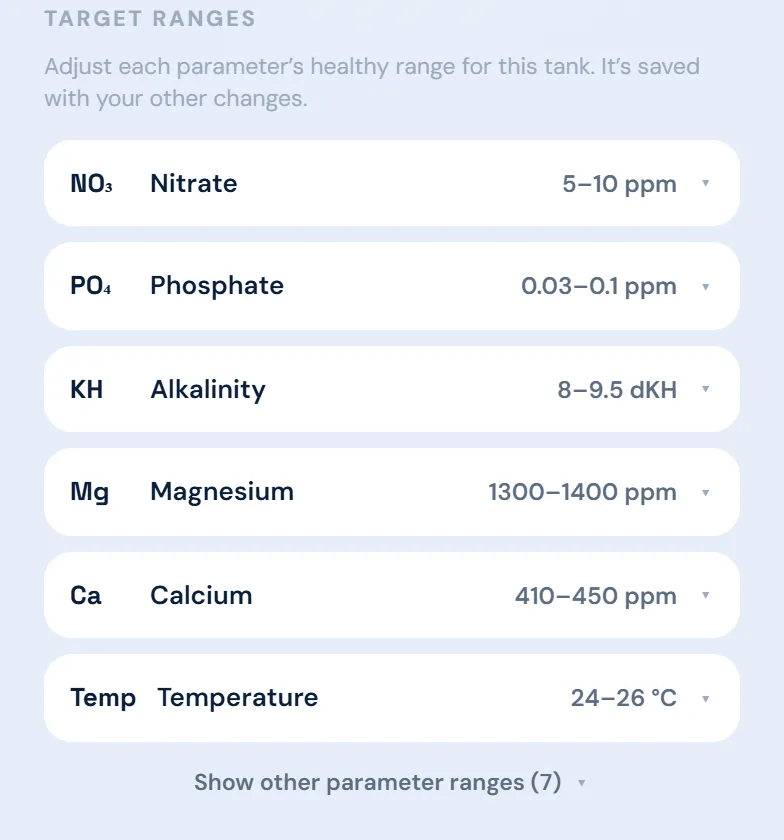
Set your target range for each parameter
When you create an aquarium, Salicora suggests the ranges in the “Salicora default” column of the chart. You can adjust them to your system (for example, lower nutrients if you keep SPS) and choose your key parameters, the ones that count towards your tank’s health score.
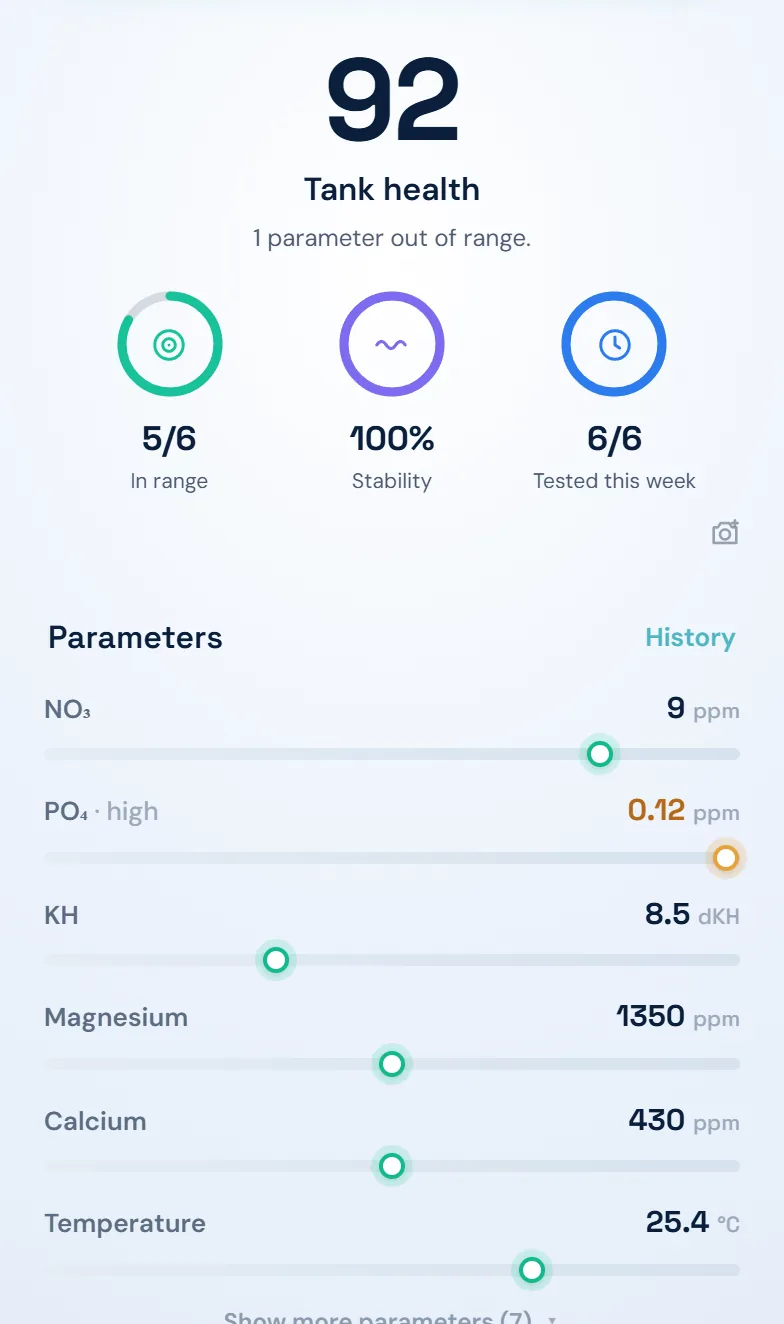
At a glance: what’s out of range
The dashboard sums up your water quality in a health score and shows each parameter on its range bar. Here: health 92, 5 of 6 parameters in range and phosphate flagged as high (0.12 ppm against a 0.03–0.1 target).
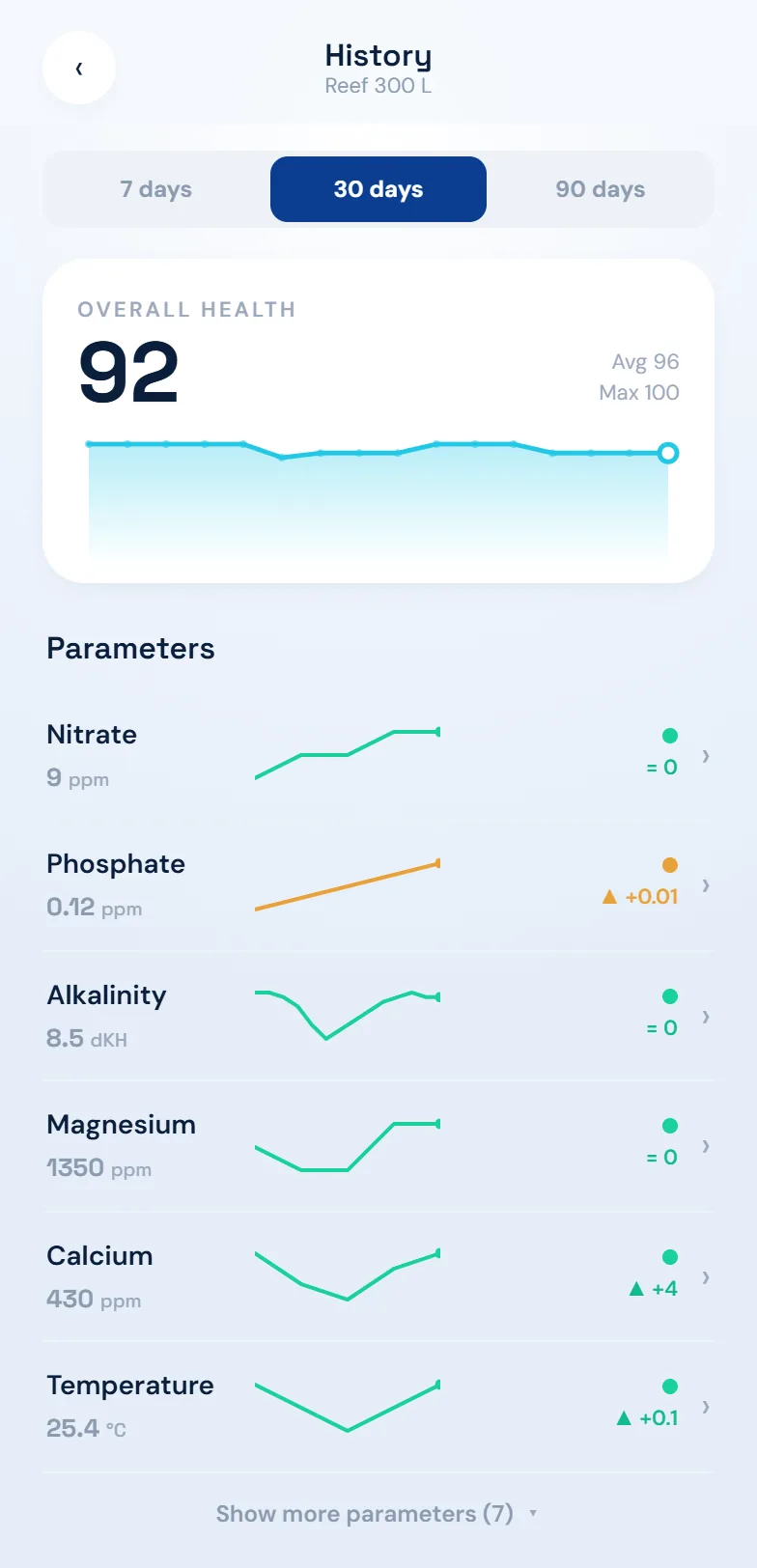
Every parameter’s trend at once
The history shows a mini chart of each parameter over the last 7, 30 or 90 days, with its change from the previous test. That way you catch whatever is drifting slowly, like the phosphate in this demo, before it turns into algae.
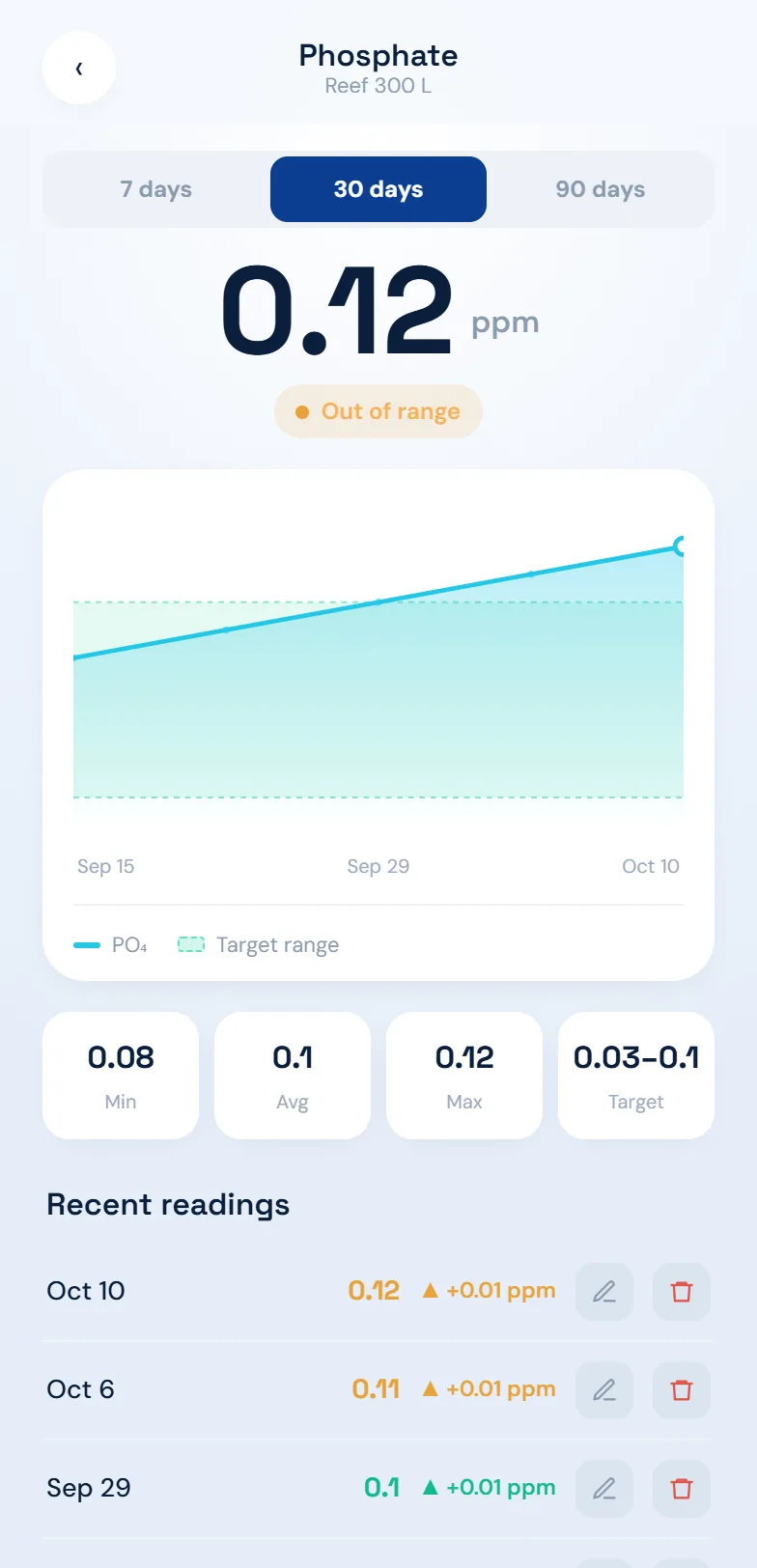
Each parameter in detail
Open a parameter to see its chart over the target band, the period’s minimum, average and maximum, and every reading with its change. In this demo phosphate rises by a few hundredths each week: time to review feeding, water changes or your phosphate-removal media before algae shows up.
If you have questions, you can ask the AI assistant: it answers with your tank’s test results, not generalities.
Water parameters FAQ
Which parameters should I test in a saltwater aquarium?
The basics are salinity, temperature, alkalinity (KH), calcium, magnesium, nitrate and phosphate. During cycling, ammonia and nitrite too. In reefs with lots of stony corals it’s worth checking potassium, iodine and other elements now and then, for example with an ICP test.
What is the ideal salinity for a reef tank?
A specific gravity of 1.025–1.026, which is about 34–35 ppt, very close to natural seawater. What matters is keeping it stable by topping off evaporation with RO/DI water, not saltwater.
Why shouldn’t nitrate and phosphate be at zero?
They are nutrients that corals and their zooxanthellae also use. With zero readings for weeks, corals can lose color and grow less. The usual aim is low but measurable levels, for example NO₃ 1–10 ppm and PO₄ 0.03–0.1 ppm.
How often should I test my water parameters?
Temperature and salinity daily or several times a week. KH, calcium, nitrate and phosphate once a week (KH more often while you adjust dosing). Magnesium every one or two weeks, and potassium, iodine or fluoride once a month or with an ICP test.
Are the values the same for every aquarium?
No. These are guideline ranges for a mixed reef. Soft coral tanks tolerate more nutrients, while SPS tanks usually run lower and more stable. Choose a target for your system and keep it stable.
Track your water parameters in Salicora
Log your tests, set your target ranges and see at a glance what’s drifting out. Free, right in your browser.
Start free