Stable KH in a reef tank: why it matters and how to keep it there
KH is one of the parameters with the biggest impact on the health of a reef. Here’s which range to aim for, why keeping it from swinging matters more than the exact number, and how to stay on top of it day to day.
KH (alkalinity) measures the carbonates and bicarbonates in the water: they buffer pH swings and are the building material corals and coralline algae use for their skeletons. In a reef tank it is usually kept between 7 and 11 dKH. What matters is picking a target and keeping it stable: as a rule of thumb, no more than 0.5 dKH of change in 24 hours.
What KH is and where it comes from
In the saltwater hobby, “KH” and “alkalinity” are used interchangeably. It measures the amount of dissolved carbonates and bicarbonates and is expressed in dKH (degrees of carbonate hardness) or meq/L.
Stony corals, clams and coralline algae take up those carbonates, together with calcium, to calcify. That’s why KH drops on its own in a living reef: the more the system grows, the more it consumes. Water changes replenish it and, when they aren’t enough, so does dosing (sodium bicarbonate, the Balling method, kalkwasser or a calcium reactor).
Why stability matters more than the number
A reef adapts well to a KH of 7.5 or 9 dKH as long as it stays there. What it doesn’t handle well are sudden changes:
- Stressed corals. Swings are linked to closed polyps, loss of color and, in SPS corals, tissue necrosis.
- Less stable pH. With low alkalinity, pH swings more between day and night.
- Risky corrections. Raising it a lot at once to “fix” a low KH often does more harm than the low KH itself.
So the practical goal is twofold: know your daily consumption and replace it steadily, so the chart is an almost flat line.
| Situation | What it usually means |
|---|---|
| KH stable within your range | What you add (water changes + dosing) covers consumption. Keep doing what you’re doing. |
| Slowly dropping over several days | Consumption has increased (the corals are growing) or the dose has fallen short. |
| Sudden drop | Empty dosing container, stopped dosing pump or a test error. Retest. |
| Rising above your target | Too high a dose or a high-KH salt mix in water changes. Reduce what you add, without stopping all at once. |
How to test it properly
- Same time of day. Always test at roughly the same time, for example before the lights come on, so readings are truly comparable.
- Same test kit. Switching brands mid-way can show jumps that aren’t real. Check your reagents’ expiration dates.
- Frequency depends on the moment. While you’re adjusting dosing, every day or every 2–3 days. Once it’s been stable for weeks, once or twice a week.
- Log every reading. A single value says little; the trend over several weeks is what really tells you something.
How to work out your KH consumption
Test on two separate days without dosing in between, subtract and divide by the number of days. If you read 8.6 dKH on Monday and 8.3 dKH on Thursday, your consumption is (8.6 − 8.3) / 3 = 0.1 dKH per day. That’s how much you need to add back each day for KH to hold steady. If you already dose, add what your daily dose contributes.
How to track KH in Salicora
These screenshots come from a demo account with three months of data. They tell a very common story: KH was low, it gets corrected little by little, it holds steady… and one day the dosing container runs dry.
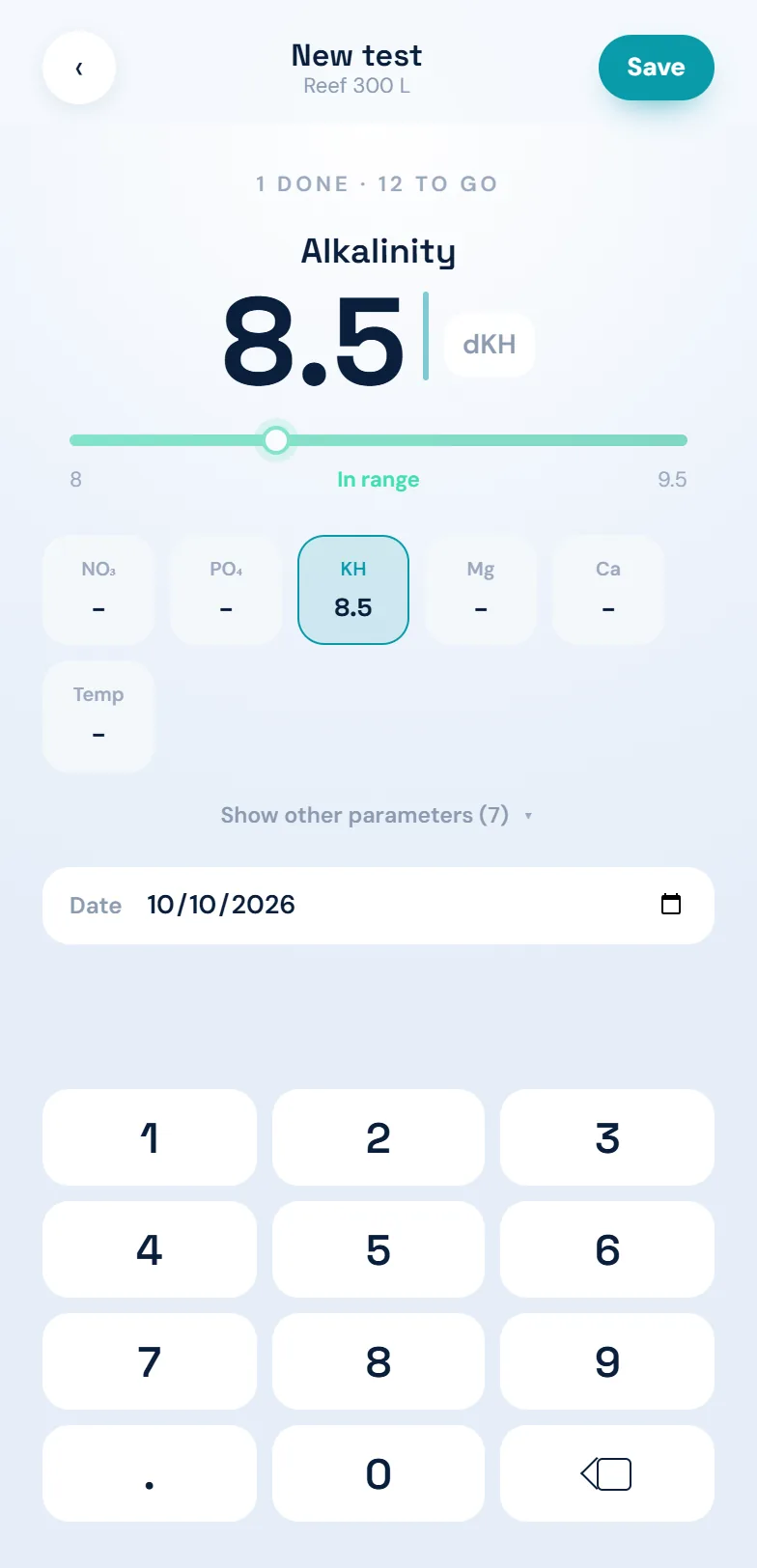
Log every test in seconds
Pick the parameter, type the value and the bar instantly tells you whether you’re inside your target range, which you set for each aquarium. On the same screen you can record the rest of your test results (calcium, magnesium, nitrate, phosphate…).
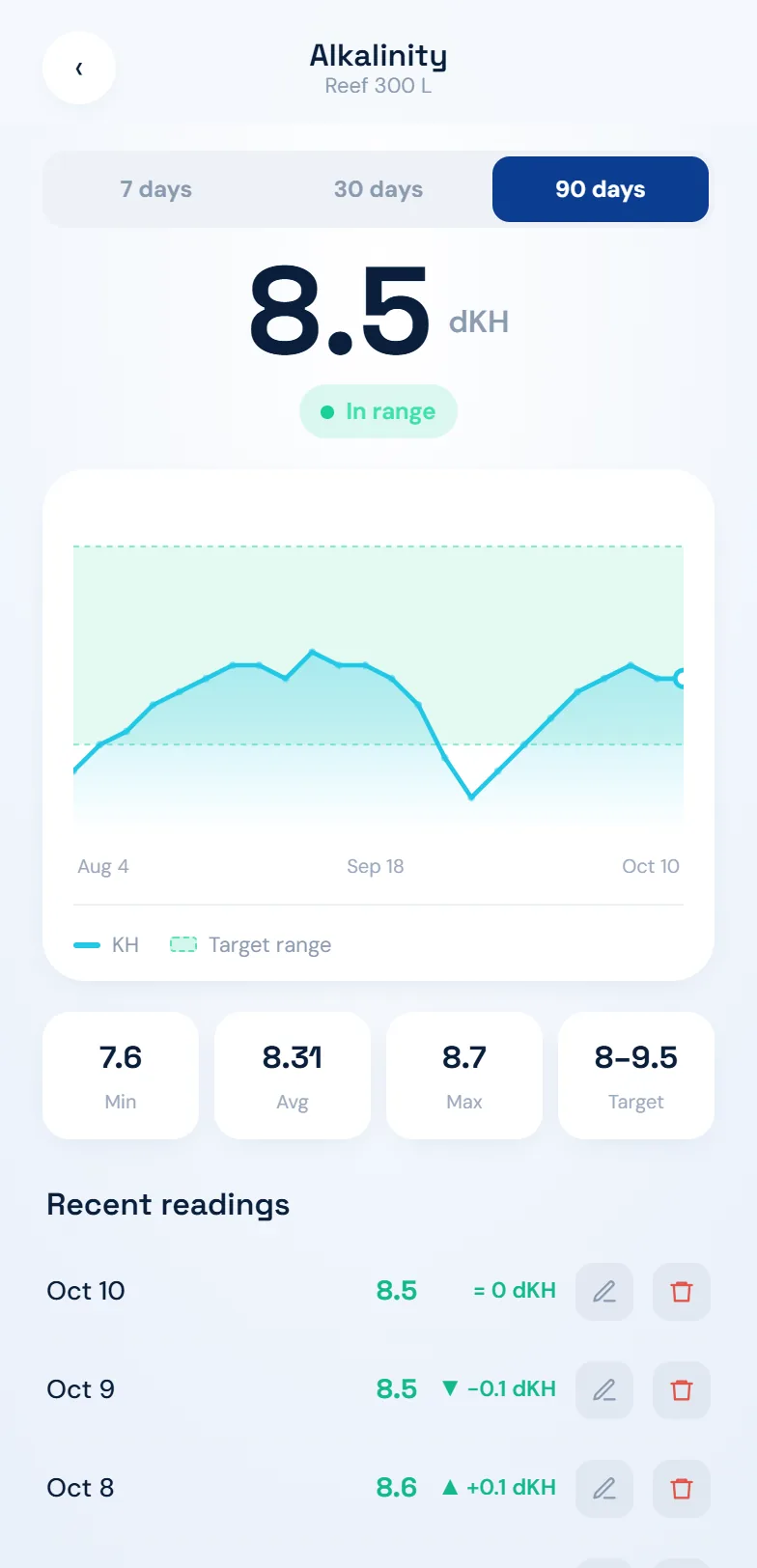
Look at the trend, not a single value
The chart shows all your readings over the band of your target range. This one tells the whole story:
- August: KH was at 7.8 dKH, below target. It’s raised gradually, a few tenths a week, up to 8.6.
- September: three weeks stable between 8.5 and 8.7 dKH.
- Sep 21–26: it drops to 7.6 dKH. The KH solution container had run empty.
- October: it’s refilled and KH recovers gradually to 8.5 dKH, with no sudden jumps.
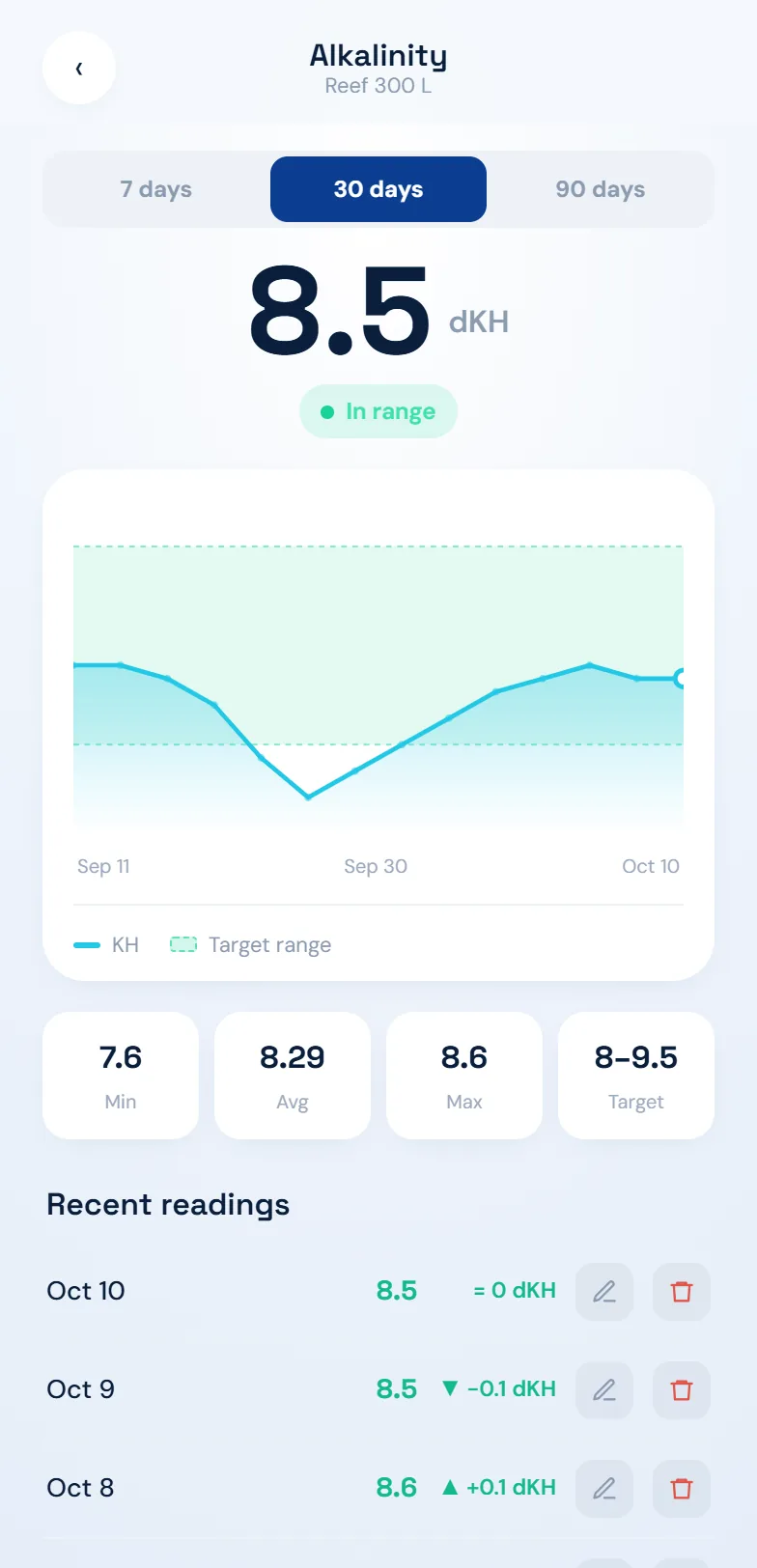
Check that the swings are small
The list of recent readings shows how much KH changed from one test to the next (“▲ +0.1 dKH”, “▼ −0.1 dKH”). It’s the fastest way to know whether you’re keeping to the rule of no more than 0.5 dKH per day, including while you correct a dip.
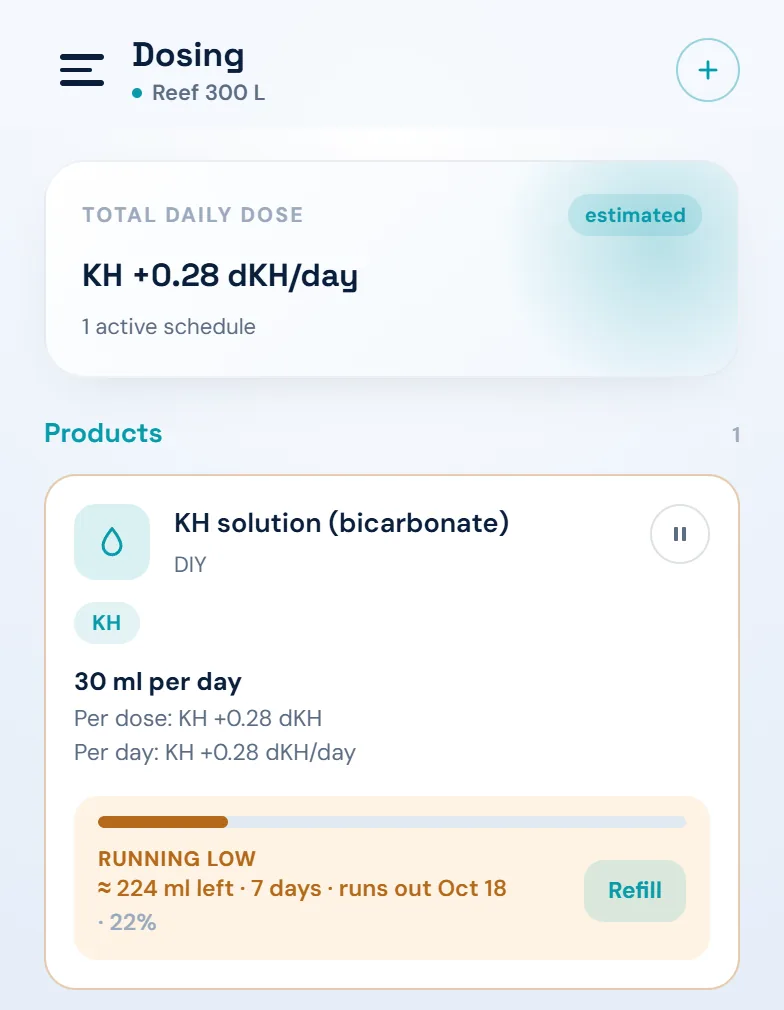
Never run out of solution again
When you log your dosing, Salicora calculates the estimated daily contribution; here, 30 mL a day of a bicarbonate solution adds about 0.28 dKH per day. That way you can compare it with your consumption.
It also keeps track of what’s left in the container and warns you before it runs out, by email too. That’s exactly what would have prevented September’s dip.
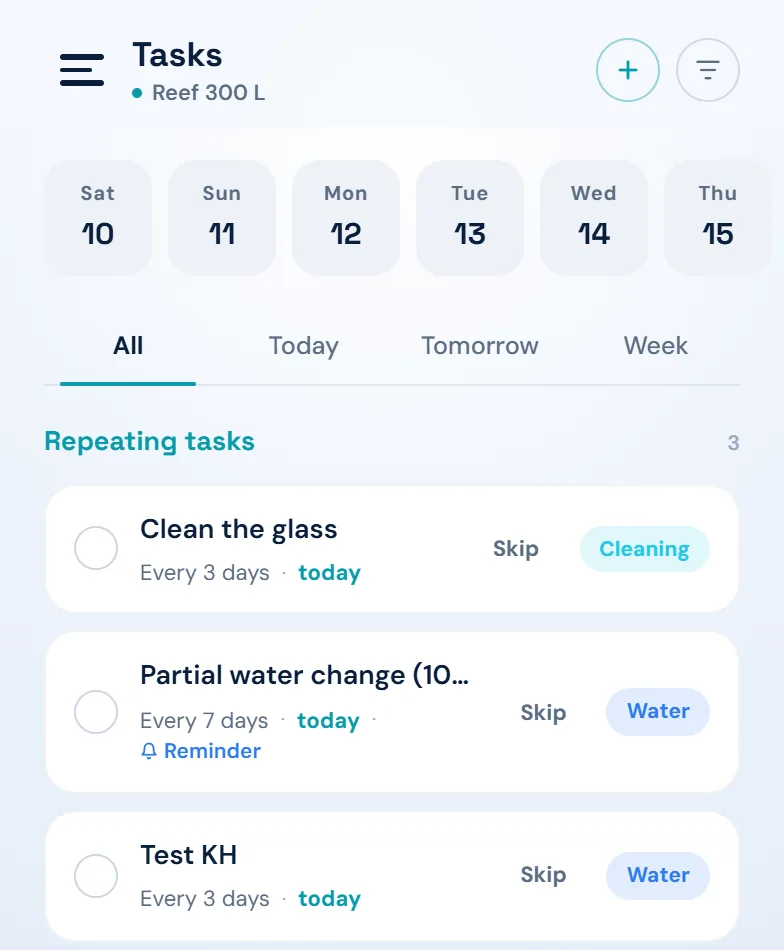
Test consistently without having to remember
Create a recurring task, such as “Test KH every 3 days”, and Salicora reminds you of it along with the rest of your maintenance: water changes, cleaning… If you like, it can also email you on the day it’s due.
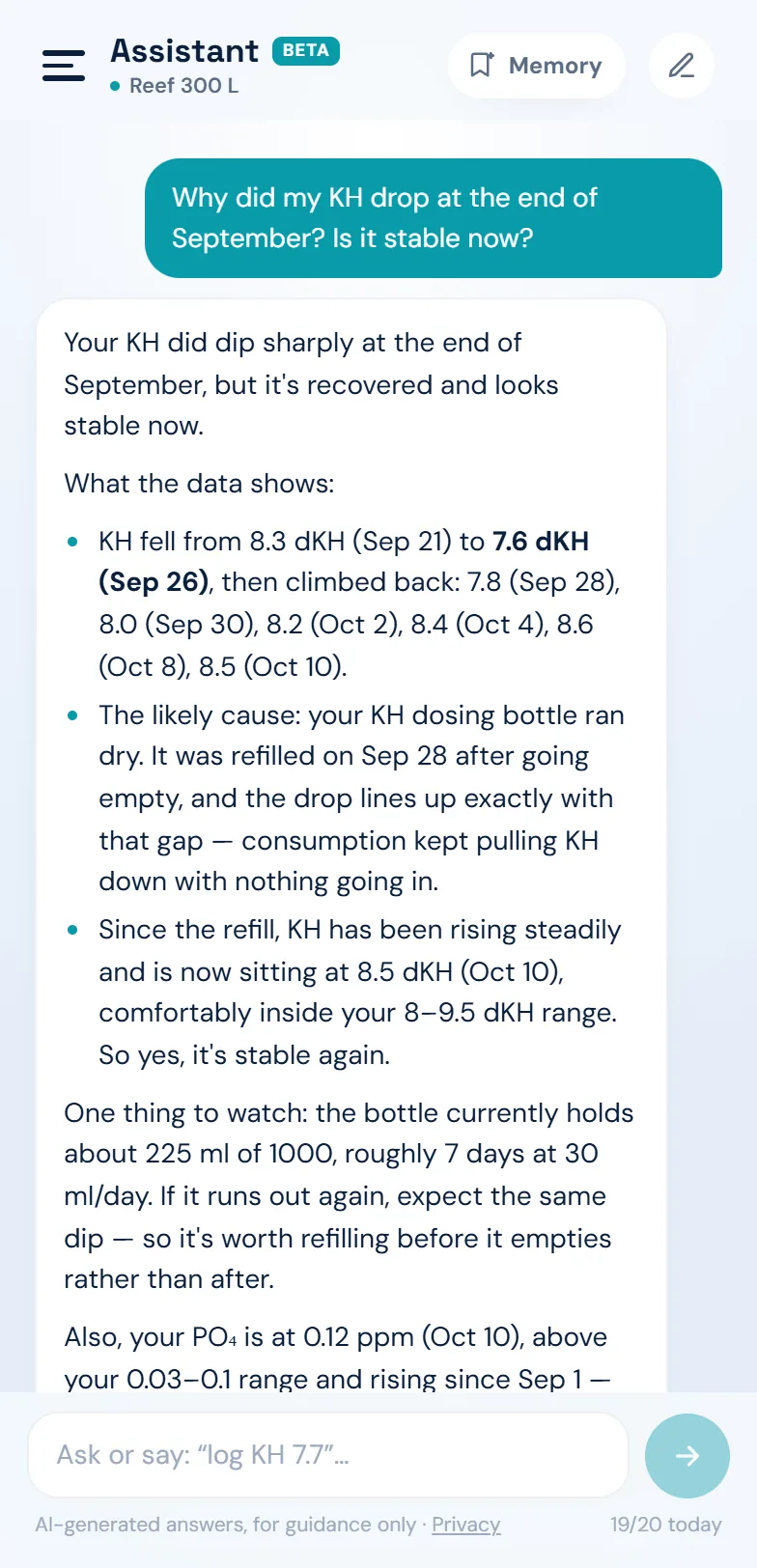
Ask the assistant why it changed
Salicora’s AI assistant answers with your tank’s data, not generalities. Asked “Why did my KH drop at the end of September? Is it stable now?”, it:
- finds the drop in the series: from 8.5–8.7 to 7.6 dKH on September 26;
- links it to dosing: the container was empty and was refilled on the 28th;
- assesses whether it’s stable again and warns you that about 7 days of product are left.
If you ask it to log a test or create a task, it gets it ready for you to confirm: it never changes anything on its own. You can also do it by voice: see the assistant and voice guide.
What to do if your KH isn’t stable
If it’s low or has dropped
- Retest to rule out a test error.
- Find the cause before dosing more: an empty container, a stopped or clogged dosing pump, a change of salt mix, or simply higher consumption because your corals are growing.
- Raise it gradually, by no more than about 0.5 dKH per day, until you’re back on target.
- Adjust your maintenance dose to your real consumption so it doesn’t happen again.
If it’s high
Reduce what you add (dose or salt mix) and let consumption bring it down gradually on its own. Avoid stopping all dosing at once, and keep an eye on calcium: with very high KH the risk of precipitation goes up.
This guide is for general guidance. Every system is different: if you have doubts with sensitive corals, change one thing at a time and watch how your tank responds.
Related guideReef tank water parameters: ideal values chart →KH FAQ
What is the ideal KH for a reef tank?
It is usually kept between 7 and 11 dKH, and many reefers pick a target between 7.5 and 9 dKH. More than the exact number, what matters is choosing one and keeping it stable.
How much can KH change in a day?
As a rule of thumb, no more than 0.5 dKH in 24 hours, and less is better. If it needs correcting, do it gradually over several days.
How often should I test KH?
While you are adjusting dosing or after a change, every day or every 2–3 days, at the same time of day. Once it has been stable for weeks, once or twice a week is usually enough.
What should I do if KH suddenly drops?
Retest to rule out a test error and look for the cause: an empty dosing container, a stopped dosing pump or higher consumption. Then raise it gradually, by no more than about 0.5 dKH per day.
What is the difference between dKH and meq/L?
They are two units for the same measurement: 1 meq/L equals 2.8 dKH. For example, 8.4 dKH is 3 meq/L.
Track your KH in Salicora
Log your tests, see the trend against your target range and get an alert before your dosing runs out. Free, right in your browser.
Start free